
Overview
Dreams is a consumer fintech platform that applies behavioral science to support saving, investing, and debt management.
Challenge
Dreams is a fintech platform built on behavioral science, designed to help people save, invest, and manage debt in ways that actually fit their lives.
Many financial apps promise to help people make better decisions, but too often they feel generic or overly promotional. When advice misses the mark, trust tends to disappear fast.
Dreams set out to see if more personalized guidance could make the app genuinely helpful and relevant, without crossing the line into being pushy or sales-driven.
The challenge was to personalize the experience in a way that actually builds user trust and confidence, while still supporting Dreams’ goals as a business.
User insights
We wanted to learn how people view and use savings apps, so we used both quantitative data and personal stories in our research.
We ran two surveys, one for Dreams users and one for non-users, and gathered 120 responses. This gave us a clearer sense of what motivates people, what earns their trust, and what keeps them engaged.
We also spoke with five non-users in semi-structured interviews to get a better sense of their hesitations, their confidence, and what might be holding them back.
While we couldn't interview current users directly, their perspectives still came through in the survey responses.
What stood out most was that personalization is less about perfect recommendations and more about helping people feel confident and stay engaged.

HOW MIGHT WE
In our research, we explored how social dynamics can help people stay financially motivated over the long term, without adding pressure or judgment.
This brought us to these design questions:
Hypothesis And Assumptions
primary hypothesis
Working with others to save money or pay off debt can help users stay motivated long-term, especially if social pressure is low.
Supporting Assumptions
Concept Exploration
Based on our hypothesis and supporting assumptions, we explored three complementary concepts:
1. Group Savings
When people set financial goals together, motivation tends to grow. There’s a sense of responsibility and support that comes from working as a group. Many participants told us they felt more committed when their progress mattered to others, not just themselves.
We wanted to see if this effect would last with longer-term goals. By combining shared goals with straightforward, useful guidance, we believed Dreams could help people save over time—without making things feel complicated or overwhelming.

2. Guided Support
We heard from users that savings and debt features can feel intimidating. Many people worry about making a wrong move with their money, and that uncertainty often keeps them from getting started.
We wondered if a friendly mascot might help take the edge off decision-making. Instead of pushing features or acting like an expert, the mascot would simply be there to reassure, explain things in plain language, and let people move at a pace that feels comfortable. And of course, the mascot would always be optional.

3. Financial Overview
A number of people told us they wanted a clearer sense of where their money goes. Before thinking about saving, they needed to understand their income and expenses.
A full budgeting tool might have solved this, but we chose to keep our focus on personalization, motivation, and the social side of saving.
Adding full financial tracking would have pulled us away from what we set out to do. So instead, we added a straightforward financial overview.
The goal was to help people feel more confident and make it easier to work toward shared goals, all without adding unnecessary complexity.

Iteration And Validation


From Goal Creation to Progress Tracking


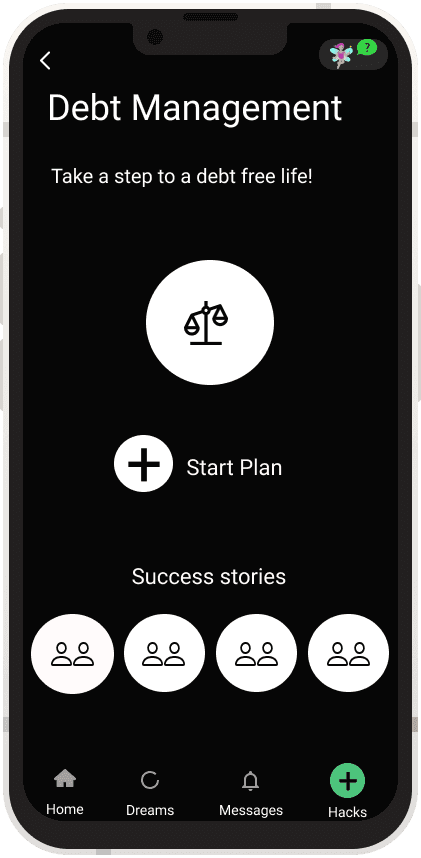
Exploring the Debt Management Experience


Outcome And Stakeholder Feedback
When we shared the final concept with Dreams' stakeholders, we walked through how our research shaped the design choices and pointed out which assumptions still needed to be tested.
Rather than positioning the concept as a finished solution, we treated it as an exploration—looking at how social motivation might be used thoughtfully and responsibly in a fintech setting.
Stakeholders appreciated our focus on trust and restraint, particularly the decision to put supportive social interactions ahead of heavy-handed personalization.
They also suggested we narrow the scope. In their view, the concept could have been even stronger if we had focused on developing one main idea more deeply, instead of spreading our attention across several.
Reflections
This project was a good reminder of how important it is to keep a tight scope, especially when you’re exploring new territory.
Trying to chase too many hypotheses at once made it harder to dig deep and really understand what was working. If I were to do it again, I’d focus sooner and build more specific experiments around social motivation as the main idea.
With more time, I’d keep testing the guided support idea. Early feedback was promising, but I’d want to see how it holds up over time. Especially when it comes to building trust, encouraging engagement, and shaping how people feel about the brand in a financial setting.
I was glad to see that Dreams later added success stories to the app, which lined up with our suggestion to focus on progress and positive reinforcement instead of financial pressure.
It doesn’t prove our concept, but it did show that we were on the right track about what motivates people when it comes to money.


